Showing posts with label Colours. Show all posts

Thursday, 23 April 2015

WHY THE YELLOW SEA IS CALLED THE “YELLOW SEA”?

WHY THE YELLOW SEA IS CALLED THE “YELLOW SEA”?

PROF WAQAR HUSSAIN


        Yellow Sea, Chinese Huang Hai, is an arm of the Pacific Ocean. It is lying between mainland China on the west and north and the Korean peninsula on the east. It is situated to the north of the East China Sea.  It measures about 960 km from north to south and about 700 km from east to west. 

The area of the Yellow Sea 380,000 km2); its mean depth is 144 ft.
There are many hypotheses for its name.

1) The sand particles flying from the sand storm of Gobi Desert and fall into it that turn the surface of the 
water golden yellow.
2) Many major Chinese rivers like the Bohai Sea, Hai He River that contain golden colour silt fall into it. This golden silt changes the colour of the water to paler one.

3) Turks associated directions with the colors as: 


·      Black (Kara) is associated with North (Kuzey); Before Turkish conquest of Anatolia and Middle East, the Black Sea had known by Greeks as Pontos Euxeinos. 

·      White (Ak) is associated with West (Batı); Aegean and Mediterranean Seas as The White Sea (Akdeniz)
·      Red (Kızıl) is associated with South (Güney); the sea between Arabian Peninsula and Egypt as The Red Sea (Kızıldeniz)
·      Blue (Mavi in modern Turkish, Kök in old Turkish) is associated with East (Doğu) and
·      Yellow (Sarı) is associated with the Center.

                 Probably the Chinese used the same system of colours and directions and called this centrally located sea as the Yellow Sea. (Sarı Deniz in Turkish)

Wednesday, 22 April 2015

WHY THE WHITE SEA IS CALLED THE “WHITE SEA”?

WHY THE WHITE SEA IS CALLED THE “WHITE SEA”?

PROF WAQAR HUSSAIN

    
The White Sea is an inland sea in the north-eastern European part of Russia that belongs to the Arctic Ocean. It has an area of 90000 km3, mean depth of 197 ft and houses 700 invertebrate specie. The White Sea was first called "the White Sea" on the map drawn by Petrus Fiancius in 1592.

There are many hypotheses about the name of White Sea.
1) One hypothesis suggests that the name 
comes from the fact that the sea is covered with ice for six to seven months every year,from September to May. It's the only sea in Europe completely covered with ice in winter.
2) Some say that the name originates from the whitish color of the water, reflecting the northern sky.

3) There is a constant water exchange with the Barents Sea as 2000km3 and 2200km3 of fresh water flow in and out of the White Sea respectively that results in decreased salinity of water and increased amount of silicon and silicates in water. Silicon has silvery metallic lustre and Silicates have the property to sparkle in the sun light. Thus, elevated silicon and silicates concentration results in glittering and thus appearance the sea become white shiny. So it is called the White Sea.

Tuesday, 21 April 2015

WHY THE BLACK SEA IS CALLED THE “BLACK SEA”?

WHY THE BLACK SEA IS CALLED THE “BLACK SEA”?


PROF WAQAR HUSSAIN

       The Black Sea is a turban shaped sea lying on the head of Turkey. It is lying between South Eastern Europe and Asia with area of 436400km2 and have maximum depth of 2212m.It is surrounded by six different countries Turkey, Bulgaria, Romania, Ukraine, Russia and Georgia.
There are many hypotheses about the name of the Black Sea.

1) In ancient time, various colours were assigned to different directions; black for north, red for south, yellow for east and white for west. As it was located in the north of the Mediterranean Sea for which the ancients believed to be situated in the middle of the earth. So it was called Black Sea meaning a sea in the north.

2) The Black Sea's deep waters are much less saline as a result the microalgae concentration is much richer, causing the colour to become darker. 

3) Bulgarian view about the name is that the sea used to be quite stormy. Some sources stipulate that it goes back to the time of Noah's Ark. The Black Sea deluge theory is based on that idea. This idea further says that the Mt. Ararat is standing in the eastern Turkey along the coastline of the Black Sea is considered to be the landing point for Noah’s Ark.

4) According to naval science, the Black Sea has hydrogen sulphide(H2S) layer at depth of about 200 meters that supports a unique microbial population which produces black sediments probably due to Anaerobic Methane oxidation or it may be the combination of hydrogen sulphide with metallic ion to form metal sulphides. And sulphide of many metals are black like FeS, CuS,HgS, PbS, Bi2S3,etc.  For this black sedimentation, it got the name Black Sea.
5) There is lack of oxygen in the water that prevents the development of microorganisms, making it appearance black.  Black Sea has meromictic(having layer of water that don’t mix.) basin. It means the movement of water between the lower and upper layers of water is very least. It results in acute shortage of oxygen in the lower layer. The lower layers absolute free of oxygen and hence, inactive.


6) It is called the Black sea because it was a Sea of Death. In past, Sailors who caught in a storm usually died because of the absence of islands at which to harbour and the fierceness of the storms. 

7) The intense fog develops over the Black Sea especially in winter that absorbs the light, thus making the water appear black. . Visibility in the Black Sea is about five meters as compared to thirty-five meters in the Mediterranean Sea.

8) At a certain depth its waters become toxic and poisonous. Black means death or devastation. So, its poisonous nature earned the name Black Sea. 

9). The Black Sea got its name from the Ottoman Turks. 'Kara (Black)' denotes 'North' in Medieval Turkish, as in Kara Denizi- Kara Sea north of Siberian Yakut Turks, similar to Black Sea. 


10) The Black Sea was called "inhospitable sea" before Greek colonization of the area as it was difficult to navigate and its shores were inhabited by savage tribes. Once Greeks made navigation very easy, the name changed to the “hospitable sea.”
11) It is believed that the dead lay safely beneath the water of the Black Sea. Remains of ships and humans and other decomposable materials like ropes, wood, wreckages, etc can still be found at the bed of this sea even after hundreds of years. It is due to anoxic (oxygen less) nature of the lower water layers of this sea, the process of decomposition, which require oxygen, is negligibly slow, hence, the remains of the dead persist  inside the sea’s water. For dead, it common to denote the word black. So it was name the Black Sea.
 CONCLUSION

   The black sea is a strongly stratified body of water because its upper layer is less saline than deep water layer. The upper layer is dilute (less saline) due to fresh water in flow of the river mainly Danube and other rivers. The deep layer is concentrated (more saline) due to inflow of sea water from the Aegean Sea through the lower part of the Bosporus strait. The difference of densities of upper and lower layer retards vertical mixing in the black sea. Consequently, little atmosphere oxygen reaches the deeper layer which becomes anoxic (oxygen less). This anoxic lower layer allows organic rich sediment to accumulate on the bed of the Black sea without decomposition as oxygen is required for decomposition. This sedimentation also contains Iron sulphide (black coloured solid) and other sulphide which are mostly black. This black sedimentation makes the appearance darker. That is why the Black Sea is not blue rather murkier that other seas. Then, it has no major connection to any other bigger seas/ocean so dead fish; corals, etc. just sit on the floor and makes its appearance murkier.  

Monday, 20 April 2015

WHY THE RED SEA IS CALLED THE “RED SEA”?

WHY THE RED SEA IS CALLED THE “RED SEA”?

PROF WAQAR HUSSAIN

     Why it is called the Red Sea? There are numerous hypotheses hovering over without certainty.
1) The red sea water contains red coloured cyanobacteria (Trichodesmium erythraeum) which turn the blue-green water to a reddish-brown. 
2)The “Red Sea” is in fact “Sea of Reed”,( a tall slender leaved plant of the grass family growing in water or marshy area.) most likely due to the reeds of the Gulf of Suez.
3) In the Bible, Moses walked across what was known as the 'sea of reeds'. The Red Sea is simply an alternative name for 'Sea of Reeds'. Some believe that the name Red Sea came from a “mistranslation” of what should have been the Reed Sea in the Biblical story of the Exodus. The Sea of Reeds (in Hebrew Yâm-Sûph) is often mistranslated as the "Red Sea". 
4) A hypothesis favoured by modern scholars is that the name “red” refers direction of “South” just as the Black Sea refers to “North”. Sea’s located south of the Mediterranean world. In ancient languages, the colours black, red, green, and white referred to North, South, East, and West, respectively. Herodotus (a Greek historian who lived 484-425 BC) on one occasion uses Red Sea and Southern Sea interchangeably.

5) Some believes that Red Sea is named because red algae cover surface of water.
6) Other says that Red Sea is called due to reddish ting of surrounding mineral rich red hills, Harei Edom (Edom means red).
7) Hebrew word for South Palestine is Edom meaning red. The Red Sea splits into two at its northern end into the Gulf of Suez, and the Gulf of Aqaba. The name originally applied to the Gulf of Aqaba, which bordered the land of Edom, which means "red".
8) Yet another says it's from the colour of the setting sun over the water.
9) Some historians believe the Red Sea is named for the Himyrites, a group who once lived along its shores. A local group whose own name means "red”.
10) Another view about its name is due to the colour of the coral in the sea. Coral is substance like rock formed in the sea by a group of small animals (marine invertebrates), often used in jewellery. It has colour between orange and pink.
CONCLUSION

Red sea is one of the famous seas of the world. The ancient Egyptians were the first to explore it in 2500 BC while seeking commercial route to southward. It is lying between Africa and Asia with length of 2250km, maximum width 355 km and average depth of 1608 km. It houses 1000 invertebrate species. It joins Arabian Sea with Mediterranean Sea through the Suez Canal. It is the shortest route to Europe. It cut 5500 miles (8800km) distance from the United Kingdom to India when the Suez Canal was opened in 1869.Thus it provided easy way to approach India and other southern colonies and European made best of this opportunity and grabbed colossal economic benefits and made their countries prosperous and reddened their faces. On the other hand, they shed blood to maintain their hold on the captivate countries. So there was red on the western side as well as on eastern side through the courtesy of shortest route of The Red Sea. When all is red on either side of the sea so it is aptly called the Red Sea.

Friday, 17 April 2015

WHY PUS IS WHITE?

WHY PUS IS WHITE?

PROF WAQAR HUSSAIN
          
        The pus is the dead bodies of white blood cells- body soldiers who laid down their lives while fighting with the invading enemy (bacteria) trying to disrupt body.

          Scientifically, pus is a protein-rich thick fluid “liquor puris” usually white, whitish-yellow, greenish or yellow brown. Pus consists of a buildup of dead leukocytes (white blood cells) from the body's immune system in response to infection that accumulates at the site of inflammation. If this upsurge is very near the surface of the skin it is called a pustule or pimple (phora or phinsi in Urdu and gharr in Punjabi). An accumulation of pus in an enclosed tissue space is called an abscess. The ultimate composition of pus is dead white blood cells, dead skin cells and bacteria still fighting to enhance their number and got control of body. So, there is a point of caution in dealing with pus as it can cause infection in other healthier part of bodies or in other healthy person. So, a proper care is required to get rid of pus by using proper antiseptic liquid or gel.

Thursday, 16 April 2015

DO YOU KNOW THE MOST ABUNDANT COLOUR ON EARTH?


DO YOU KNOW THE MOST ABUNDANT COLOUR ON EARTH?

PROF WAQAR HUSSAIN
        
There are 200 billion galaxies in our universe. We live in the Milky Way which contains 11 Kharab (11x1012) stars. Then, each star has many planets, planetoids, satellites, etc. Our earth is one of the planets revolving around the star, the sun. God has bestowed one special feature to earth as it is a multi coloured ball. Blue oceans, blue sky, green forests, brown continents, white snowy poles and mountain peaks. I was wondering to know the most dominant and abundant colour on the earth. That must be a special and favorite colour of God. In spite of asking people and searching from different sources; I couldn’t find my answer of the dominant colour. So I started contemplating. It may be green? But green fields are scanty on the surface of earth. It may be brown due to large chunk of soil which is brown? But 71% surface of earth is covered by oceans so ultimately, I left with only one choice i.e. blue. As the 71% of earth is covered by ocean which has Prussian blue colour and the canopy of sky is also blue.
               Suddenly, a thought flashed in my mind that during 12 hours of night, everything turn black i.e. sky, ocean, land, etc. So the dominant colour on earth is black.
              
During night, half of sky is black having area of 256473745.3 Km2 and half of surface of earth is black having area of 255036000 km2 so the total area of black patch is to the tune of 511509745.3 km2 (about 51 million km2)
               
Whereas, the blue colour dominate during day time when 256473745.3 km2   area of half of sky is blue and half of surface of ocean i.e. 181075560 km2 is blue. Total blue area covers to 437549305.3 km2 ( about 44 million km2) The remaining land area is brown, green, white, etc but has no significant value as all other colours have area of just 73960440 km2.                                     


           So, we come to conclusion that during night black is dominant colour and during daytime is blue. And in 24 hours, black colour 53.9% and blue is 46.1%.So black colour is 17% more abundant than blue. Other colours are too minute to be considered. As black is not a colour but it is the indication of absence of colours so the blue colour is the most abundant colour on the earth.

Friday, 6 March 2015

Why will a white roof keep your house cooler in summer than will a black roof?

Why will a white roof keep your house cooler in summer than will a black roof?

PROF WAQAR HUSSAIN


         White colours repel heat rays. Therefore white roof absorbs comparatively less heat and reflects the heat outward. But the black roof absorbs the heat and does not reflect it. Hence the house with a white roof is cooler.

          White painted roofs had been in vogue since ancient times in places like Greece. Such roofs are designed to reflect more sunlight and absorb less heat than a standard roof. These are made of a highly reflective type of white paint, a white sheet covering, white cement, highly reflective white tiles, white pebbles or white foam. Even one can white wash the roof with lime water, Ca (OH) 2. Such roofs maintain lower roof temperatures. When standard or dark roofs touch temperatures of 150°F; cool roofs, under the same conditions, stay at 50°F.It means the white reflecting covering are cooler three times than the normal roofs.

Friday, 24 October 2014

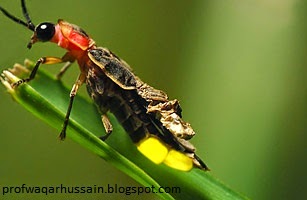
Why fire flies emits light?

Why fire flies emits light?

PROF WAQAR HUSSAIN

                   Fireflies appear to light up for a variety of reasons.

            First, the larvae of fire fly produce short glows. The adult Fireflies produce defensive steroids in their bodies that make them unpalatable to predators. So, the Larvae use their glows as warning displays to communicate their distastefulness.
             Second, many fireflies have flash patterns unique to their species and use them to identify other members of their species.

            Third, flash patter is used to discriminate between members of the opposite sex. Female fireflies prefer and love males having higher flash rates and high intensity of flash light.

Why fir flies produce flash of light?


 Why fir flies produce flash of light?


PROF WAQAR HUSSAIN

             The nitric oxide gas plays a critical role in firefly light flashing. Probably, when the firefly light is off, no nitric oxide is being produced so vessels providing oxygen are blocked. Nitric oxide is widely used in Viagra as it expands the blood vessels and increases the blood supply to the sex organ. Similarly it is used in heart attack as it widens the blood vessels and unblocks the constriction created by clot. Pomegranate is considered vital fruit for the patients and there is famous maxim in Urdu aik annar, so bemar (There is one pomegranate and the patients are hundred meaning the demand is too high and remedy is scarce.)

              The more proper reason of the flash of light of fire flies is:  When the firefly light is off, no nitric oxide is being produced. In this condition, oxygen entering the light organ is seized by the cell's energy-producing organelles “mitochondria” and thus oxygen is not available to light producing cells. In the presence of nitric oxide, which binds to the mitochondria, thus allows oxygen to flow into the light producing cells where it combines with the other chemicals needed to produce the bioluminescent reaction.  Nitric oxide breaks down quickly and till the new nitric oxide is produced, the oxygen molecules are again trapped by the mitochondria and are not available for the production of light. This supply and stoppage of nitric oxide is responsible for the flashing of fire flies light.

How firefly emits light?


How firefly emits light?

PROF WAQAR HUSSAIN

           Fire flies are winged beetles of insect family, comprising of 2000 species. Fire flies are also known as glow worm and light bug because they produce cold light of wavelength 510 to 670 nanometers. Light is produced due to a process called bioluminescence occurring in the cells of its lower abdomen with the help of a chemical luciferin(light bearer) which under goes enzyme catalyzed oxidation and an “intermediate” is formed in excited state that when returns to ground state, emits light. This light emitting process proceeds in two reactions:  

First, luciferin combines with adenosine triphosphate(ATP) to form luciferyl adenylate and pyrophosphate(PPi) in the presence of magnesium ions on the surface of enzyme luciferase.
              
(1) Luciferin + ATP  Luciferyl adenylate + PPi


Second, luciferyl adenylate combines with oxygen to form oxyluciferin and adenomonophosphate(AMP) and light is produced.


             (2) Luciferyl adenylate + O2   Oxyluciferin +AMP+Light


   The light producing cells also have crystal of uric acid which reflects the light away from the abdomen. Fire flies have no lungs thus oxygen is supplied. through special tubes called trachea. The switching of light on and off is controlled by nerve cells or oxygen supply. 

Sunday, 19 October 2014

Why Chameleons Change Colours?


Why Chameleons Change Colours?

PROF WAQAR HUSSAIN

               Chameleon are specialized clade of lizards that has 600 species, many has distinctive magical property of change of colour of their skin. Chameleons are famous for their quick color-changing abilities for three main reasons; first, to regulate their body temperatures; second, for social signaling and third, for camouflage.
             

 Heat regulation: Since chameleons can’t generate their own body heat so they change the color of their skin in a way to maintain optimum body temperature.  Chameleons in cold weather become dark to absorb more heat, whereas in hotter times, turn into lighter grey colour to reflect most of the sun’s heat.
             

Social Signaling: Chameleons’ changes colour to communicate their feeling. Males become bright to signal their dominance and turn dark in aggressive mood.  Males show lighter, multicoloured patterns when courting females.
Females can let males know if they are willing to mate by changing the color of their skin.
              Camouflage: Some species adjust their colors for camouflage in accordance with the vision of the specific predator species (bird or snake) by which they are being threatened.

                Chameleons are domesticated so Owners should know their colour language to get to their inner feeling.
 How chameleon changes their colours?
             The outermost layer of the chameleon’s skin is transparent. Beneath this are three 
more layers of skins which contain specialized cells called chromatophores. The chromatophores at each layer are filled with sacs of different kinds of pigment.
         Chromatophore cells in the first and upper layer are called xanthophores(yellow pigment) and erythrophores(red pigment).
         Chromatophores cells in second and middle layer are called iridophores or guanophores; these contain guanine appearing blue or white.
       Chromatophores cells in the third and the deepest layer called melanophores; contain melanin, the dark brown pigment.

           These pigments are packed in tiny sacs within the cells.  When a chameleon experiences changes in body temperature or mood, its nervous system tells specific chromatophores to expand or contract.
For instance, an excited chameleon might turn red by fully expanding all his erythrophores, blocking out the other colors beneath them
         With these layers of cells, some chameleons are capable of producing a dazzling array of reds, orange, pinks, yellows, blues, greens, purple, black and browns. These bold statements won’t help them blend into the background, but they will allow them to get their message across to other chameleons loud and clear.

WHY PEOPLE ARE AGAINST YOU INSPITE OF YOUR DEVOTION ???

 WHY PEOPLE ARE AGAINST YOU INSPITE OF YOUR DEVOTION ??? If people don’t respects you, it is your fault !  If people ignore you,  because yo...