Friday, 6 March 2015

Why will a white roof keep your house cooler in summer than will a black roof?

Why will a white roof keep your house cooler in summer than will a black roof?

PROF WAQAR HUSSAIN


         White colours repel heat rays. Therefore white roof absorbs comparatively less heat and reflects the heat outward. But the black roof absorbs the heat and does not reflect it. Hence the house with a white roof is cooler.

          White painted roofs had been in vogue since ancient times in places like Greece. Such roofs are designed to reflect more sunlight and absorb less heat than a standard roof. These are made of a highly reflective type of white paint, a white sheet covering, white cement, highly reflective white tiles, white pebbles or white foam. Even one can white wash the roof with lime water, Ca (OH) 2. Such roofs maintain lower roof temperatures. When standard or dark roofs touch temperatures of 150°F; cool roofs, under the same conditions, stay at 50°F.It means the white reflecting covering are cooler three times than the normal roofs.

Friday, 24 October 2014

Why fire flies emits light?

Why fire flies emits light?

PROF WAQAR HUSSAIN

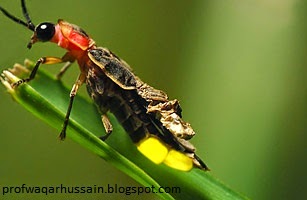
                   Fireflies appear to light up for a variety of reasons.

            First, the larvae of fire fly produce short glows. The adult Fireflies produce defensive steroids in their bodies that make them unpalatable to predators. So, the Larvae use their glows as warning displays to communicate their distastefulness.
             Second, many fireflies have flash patterns unique to their species and use them to identify other members of their species.

            Third, flash patter is used to discriminate between members of the opposite sex. Female fireflies prefer and love males having higher flash rates and high intensity of flash light.

Why fir flies produce flash of light?


 Why fir flies produce flash of light?


PROF WAQAR HUSSAIN

             The nitric oxide gas plays a critical role in firefly light flashing. Probably, when the firefly light is off, no nitric oxide is being produced so vessels providing oxygen are blocked. Nitric oxide is widely used in Viagra as it expands the blood vessels and increases the blood supply to the sex organ. Similarly it is used in heart attack as it widens the blood vessels and unblocks the constriction created by clot. Pomegranate is considered vital fruit for the patients and there is famous maxim in Urdu aik annar, so bemar (There is one pomegranate and the patients are hundred meaning the demand is too high and remedy is scarce.)

              The more proper reason of the flash of light of fire flies is:  When the firefly light is off, no nitric oxide is being produced. In this condition, oxygen entering the light organ is seized by the cell's energy-producing organelles “mitochondria” and thus oxygen is not available to light producing cells. In the presence of nitric oxide, which binds to the mitochondria, thus allows oxygen to flow into the light producing cells where it combines with the other chemicals needed to produce the bioluminescent reaction.  Nitric oxide breaks down quickly and till the new nitric oxide is produced, the oxygen molecules are again trapped by the mitochondria and are not available for the production of light. This supply and stoppage of nitric oxide is responsible for the flashing of fire flies light.

How firefly emits light?


How firefly emits light?

PROF WAQAR HUSSAIN

           Fire flies are winged beetles of insect family, comprising of 2000 species. Fire flies are also known as glow worm and light bug because they produce cold light of wavelength 510 to 670 nanometers. Light is produced due to a process called bioluminescence occurring in the cells of its lower abdomen with the help of a chemical luciferin(light bearer) which under goes enzyme catalyzed oxidation and an “intermediate” is formed in excited state that when returns to ground state, emits light. This light emitting process proceeds in two reactions:  

First, luciferin combines with adenosine triphosphate(ATP) to form luciferyl adenylate and pyrophosphate(PPi) in the presence of magnesium ions on the surface of enzyme luciferase.
              
(1) Luciferin + ATP  Luciferyl adenylate + PPi


Second, luciferyl adenylate combines with oxygen to form oxyluciferin and adenomonophosphate(AMP) and light is produced.


             (2) Luciferyl adenylate + O2   Oxyluciferin +AMP+Light


   The light producing cells also have crystal of uric acid which reflects the light away from the abdomen. Fire flies have no lungs thus oxygen is supplied. through special tubes called trachea. The switching of light on and off is controlled by nerve cells or oxygen supply. 

Sunday, 19 October 2014

Why Chameleons Change Colours?


Why Chameleons Change Colours?

PROF WAQAR HUSSAIN

               Chameleon are specialized clade of lizards that has 600 species, many has distinctive magical property of change of colour of their skin. Chameleons are famous for their quick color-changing abilities for three main reasons; first, to regulate their body temperatures; second, for social signaling and third, for camouflage.
             

 Heat regulation: Since chameleons can’t generate their own body heat so they change the color of their skin in a way to maintain optimum body temperature.  Chameleons in cold weather become dark to absorb more heat, whereas in hotter times, turn into lighter grey colour to reflect most of the sun’s heat.
             

Social Signaling: Chameleons’ changes colour to communicate their feeling. Males become bright to signal their dominance and turn dark in aggressive mood.  Males show lighter, multicoloured patterns when courting females.
Females can let males know if they are willing to mate by changing the color of their skin.
              Camouflage: Some species adjust their colors for camouflage in accordance with the vision of the specific predator species (bird or snake) by which they are being threatened.

                Chameleons are domesticated so Owners should know their colour language to get to their inner feeling.
 How chameleon changes their colours?
             The outermost layer of the chameleon’s skin is transparent. Beneath this are three 
more layers of skins which contain specialized cells called chromatophores. The chromatophores at each layer are filled with sacs of different kinds of pigment.
         Chromatophore cells in the first and upper layer are called xanthophores(yellow pigment) and erythrophores(red pigment).
         Chromatophores cells in second and middle layer are called iridophores or guanophores; these contain guanine appearing blue or white.
       Chromatophores cells in the third and the deepest layer called melanophores; contain melanin, the dark brown pigment.

           These pigments are packed in tiny sacs within the cells.  When a chameleon experiences changes in body temperature or mood, its nervous system tells specific chromatophores to expand or contract.
For instance, an excited chameleon might turn red by fully expanding all his erythrophores, blocking out the other colors beneath them
         With these layers of cells, some chameleons are capable of producing a dazzling array of reds, orange, pinks, yellows, blues, greens, purple, black and browns. These bold statements won’t help them blend into the background, but they will allow them to get their message across to other chameleons loud and clear.

Tuesday, 14 October 2014

Why plants leaves are green?

Why plants leaves are green?

PROF WAQAR HUSSAIN


          The colour of plant leaves is green due to the presence of chlorophyll in their chroloplasts. Chlorophyll is responsible for the photosynthesis and helps plant to utilize water of the ground, the carbon dioxide of atmosphere and the sunlight of the space to bind H2O and CO2 molecules to synthesis glucose and oxygen.So chlorophyll is the factory of plant which provides food for plants and oxygen for the animals.

      Chloro means green. It is an organo-mentallic complex of porphyrins esterified with long chain alcohol of phytol. Magnesium atom is present in the centre of chlorophyll. It effectively absorb blue and red light.
    The chlorophyll is green because it absorbs red and blue colour wavelengths and green is not absorbed thus it is reflected back and reach the eyes and plant looks green.

          
         With the approach of autumn, plants produce less chlorophyll because light regulates the production of chlorophyll.As a result, the green colour fade. The other pigment that affect the leaf colour are anthocyanin which makes the leaf red; caroteniods stain the leaf red, yellow or orange.

What is a Black Hole?

  What is a Black Hole? Prof Waqar Hussain  The universe is a vast tapestry of mysteries, and few phenomena capture our intellectual curiosi...